
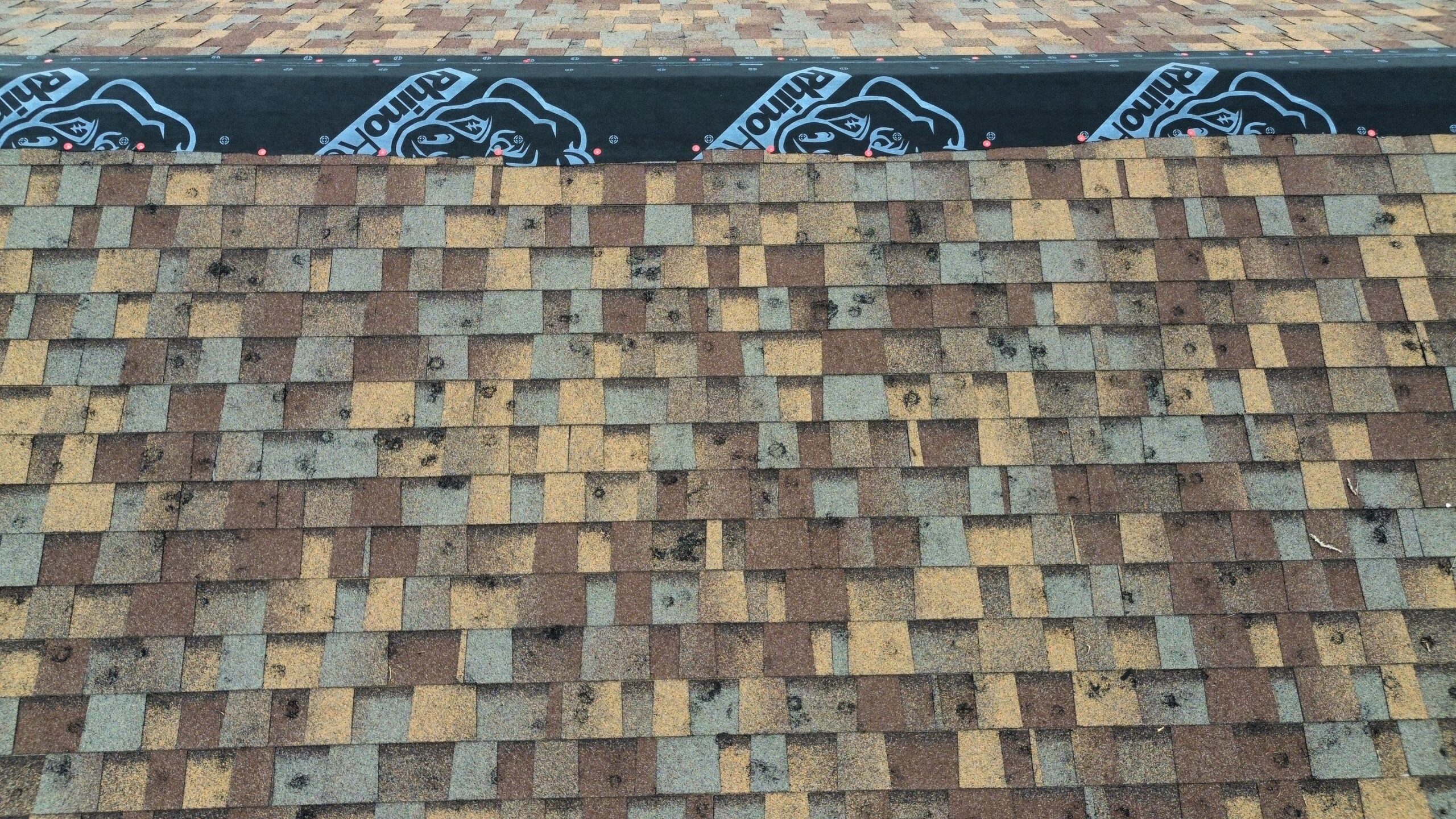
After a hail storm, one of the most common questions we hear is: “I can’t see any obvious damage from the ground — does that mean my roof is fine?” The honest answer is: not necessarily. The most significant hail damage to asphalt shingles is often invisible from ground level, and even trained eyes can miss it without getting up on the roof.
In this guide, we’ll walk through exactly what hail damage looks like at every level of your home’s exterior — and more importantly, what your insurance adjuster will be looking for when they arrive.
Why Hail Damage Isn’t Always Obvious
Asphalt shingles protect your home through a layer of granules — the gritty material that gives shingles their textured appearance. These granules deflect UV rays and shed water. When hail impacts a shingle, it bruises or displaces these granules, creating a soft spot in the shingle’s mat. Over time, that spot loses its protective coating, becomes brittle, and eventually cracks or curls.
The problem is that this bruising can be subtle. From 20 feet below, an impacted shingle can look completely normal. Up close, you’ll see a circular discoloration, a depression in the surface, or granule loss concentrated in a random pattern.
What Adjusters Look For: The Four Soft Metal Test
Here’s a trade secret: experienced claims adjusters don’t always start on the roof. They start with your soft metals — gutters, downspouts, AC condenser fins, vent caps, and window sills. These surfaces dent easily and hold the exact impression of a hail stone.
- Gutters and downspouts: Random circular dents, not from ladders or branches
- AC condenser fins: Bent or flattened fins in a pattern consistent with falling hail
- Vent caps and pipe boots: Dents on the top surface only
- Aluminum window screens: Holes or tears with rounded entry points
- Painted wood fascia: Chipped paint with exposed raw wood in a circular pattern
If you have dents in your gutters and AC unit, there is almost certainly corresponding damage on your roof. The inverse is also true — if your soft metals show zero impact, a hail claim will be hard to support.
What Hail Damage Looks Like on Asphalt Shingles
On the roof itself, adjusters are trained to look for specific patterns that distinguish hail damage from normal wear, foot traffic, or manufacturer defects. Here’s how they tell the difference:
Signs of genuine hail impact:
- Random, non-directional distribution of impact marks across the field of the roof
- Circular depressions in the shingle surface (the “bruise” shape)
- Black or dark marks where granules have been displaced, exposing the fiberglass mat
- Granule-free circles that feel softer than surrounding shingle when pressed
- The damage appears on the top of ridges, not just valleys (where water accumulates)
Signs that are NOT hail damage:
- Blistering or bubbling from manufacturing defects or poor ventilation
- Granule loss in straight lines or uniform strips (weathering pattern)
- Cracking at shingle edges (thermal splitting from age)
- Foot traffic marks — these appear in logical pathways, not randomly
- Moss or algae growth — aesthetic issue, not hail-related
Hail Damage to Metal Roofs and Tile
Metal roofing panels will show dents from significant hail, though metal is far more durable than asphalt. Small dents don’t compromise waterproofing but can void certain manufacturer warranties. Tile and slate may crack or chip — this is straightforward to identify and photograph.
How Hail Size Affects Damage Severity
- Quarter size (1″) or smaller: May cause granule loss on older shingles; significant soft metal damage
- Golf ball size (1.75″): Consistent bruising on most shingles; clear denting on gutters
- Baseball size (2.75″) and larger: Immediate penetration possible; emergency repairs likely needed
Central Texas frequently sees golf ball to baseball-size hail in the spring, particularly in Williamson County and the northern Austin suburbs including Georgetown, Leander, and Round Rock.
What To Do With This Information
If you notice any of the signs above after a hail event, contact McCannical Roofing & Exteriors for a free inspection before calling your insurance company — or at a minimum, before the adjuster visits. We’ll provide complete photographic and written documentation of the storm damage and help you determine whether filing a claim is the best option.
If you decide to move forward, having your own detailed inspection report gives you a strong, independent reference point in case the adjuster’s assessment comes in lower than expected.
(512) 238-3000
McCannicalRoofing.com
info@mccannicalroofing.com